You know the drill. A new service drops, it’s actually good, and they want you to spread the word. “Invite a friend, get a month free,” or in some cases, actual cash credits. It’s the standard playbook for Silicon Valley growth. It works for Uber, it works for Dropbox, and for a while, it seemed to be working for Perplexity AI.
Perplexity has been making waves as the “Google alternative,” and their referral program was a big part of that initial push. The deal was simple: users promoted the service, and in exchange, they received perks like Perplexity Pro subscriptions.
But recently, the narrative has shifted. Look at the discussions happening on Reddit, Twitter, and tech forums, the story isn’t about free months anymore—it’s about stuck counters, silent bans, and a program that seems to have quietly stopped working for the people who championed it, even while the links remain active.
Let’s look at the facts of what is happening with the Perplexity referral program, without the marketing spin.
The Setup: A Win-Win Proposition
When Perplexity’s referral incentives went live, the response was massive. The product itself is strong—an answer engine that cites sources is genuinely useful. Naturally, students, researchers, and tech enthusiasts started sharing their unique links.
The dashboard was straightforward. You share a link, someone signs up, you get a tick on your counter. Hit a certain number, and you get a reward. For a few months, this system appeared to function as intended. Users reported receiving their credits, and Perplexity saw a surge in user adoption.
The Glitch: When the Counting Stopped
The first sign of friction wasn’t a cancellation announcement. It was a technical “hiccup.”
A significant number of users began reporting that their referral tracking had simply frozen. You could sit next to a friend, watch them click your link, download the app, and create an account—but the dashboard would remain unchanged.
Technical glitches happen. However, the confusion stems from the duration and the silence. Users who contacted support were often met with generic responses about “eligibility criteria” or device verification.
Here is the crucial detail: While the rewards stopped tracking for many, the referral links themselves remained fully functional. They didn’t redirect to a “Program Ended” page. They continued to onboard new users to Perplexity. The funnel was open; only the reward mechanism seemed to be jammed.
The “Fraud” Flag
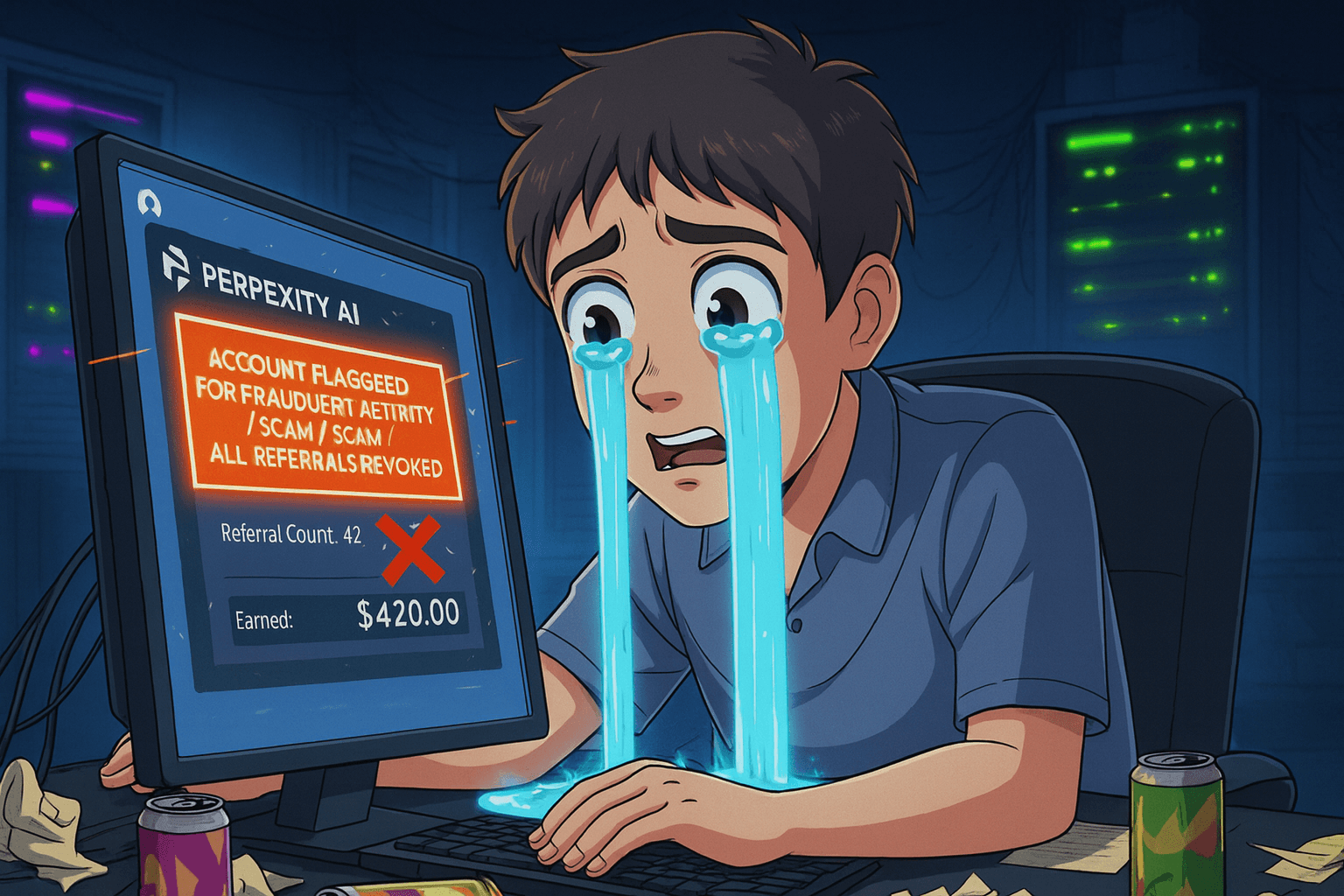
As complaints mounted about untracked referrals, a second wave of issues emerged. Users who had successfully accrued referrals—sometimes dozens of them—found themselves unable to cash out or claim their months of Pro.
Instead of rewards, many received notifications that their accounts were flagged for “fraudulent activity” or “abuse.”
Now, referral fraud is a real thing. Bot farms exist. But the volume of reports suggests a wider net was cast. We are seeing reports from:
- University students referring their verified classmates.
- newsletter writers referring their subscribers.
- Long-time users referring family members.
When these users appealed the bans, the responses often cited the Terms of Service, specifically clauses that grant the company “sole discretion” to determine the validity of a referral. There was rarely specific evidence provided—just a blanket disqualification.
The Terms of Service Reality
This is where the “fine print” becomes the main character of the story.
Like most referral programs, Perplexity’s Terms of Service likely include standard protection clauses. These usually allow the company to:
- Change or terminate the program at any time without notice.
- Disqualify users based on internal (and opaque) criteria.
- Limit rewards to “new” devices only (device fingerprinting).
While legally sound, the enforcement of these rules is what users are questioning. If a user refers ten real people, and the company flags them all as “invalid” without explanation, the user has no recourse. The company gains ten new users; the referrer gains a banned account.
The Economic Context
It is worth noting the economics at play here. Perplexity is an AI company, and AI compute is incredibly expensive. Every query costs money.
In the early stages of a startup, “Customer Acquisition Cost” (CAC) is a metric that investors watch closely. A referral program is a way to lower that cost. But if a program becomes too successful, the cost of fulfilling those rewards (paying out cash or giving away expensive Pro compute time) can balloon rapidly.
When a company suddenly tightens the reins on a referral program—stopping payouts, flagging users, or freezing trackers—it often correlates with a need to control burn rate.
The Current State
As of right now, the situation remains ambiguous.
- The Links: Still active. You can still generate a link and send it to a friend.
- The Rewards: Highly inconsistent. Some users claim it works; many others claim they are ghosted.
- The Support: Largely automated or silent regarding specific referral disputes.
The community is left in a strange limbo. They are still technically “partners” in Perplexity’s growth, holding the links that drive traffic, but the reciprocal part of the relationship—the reward—appears to have been paused indefinitely for a large segment of the user base.
A Question of Honor
Perplexity says that these accounts were flagged for security reasons, and Perplexity is an innovative company. They claim that the tracking issues are complex technicalities, and Perplexity is a technically brilliant company. And they maintain that keeping the referral links active—gathering thousands of new users for free while the referrers get banned—is standard procedure, and Perplexity is an ethical company.
So, one must wonder: If they are indeed so innovative, brilliant, and ethical, why does their fraud detection system look so suspiciously like a budget cut?